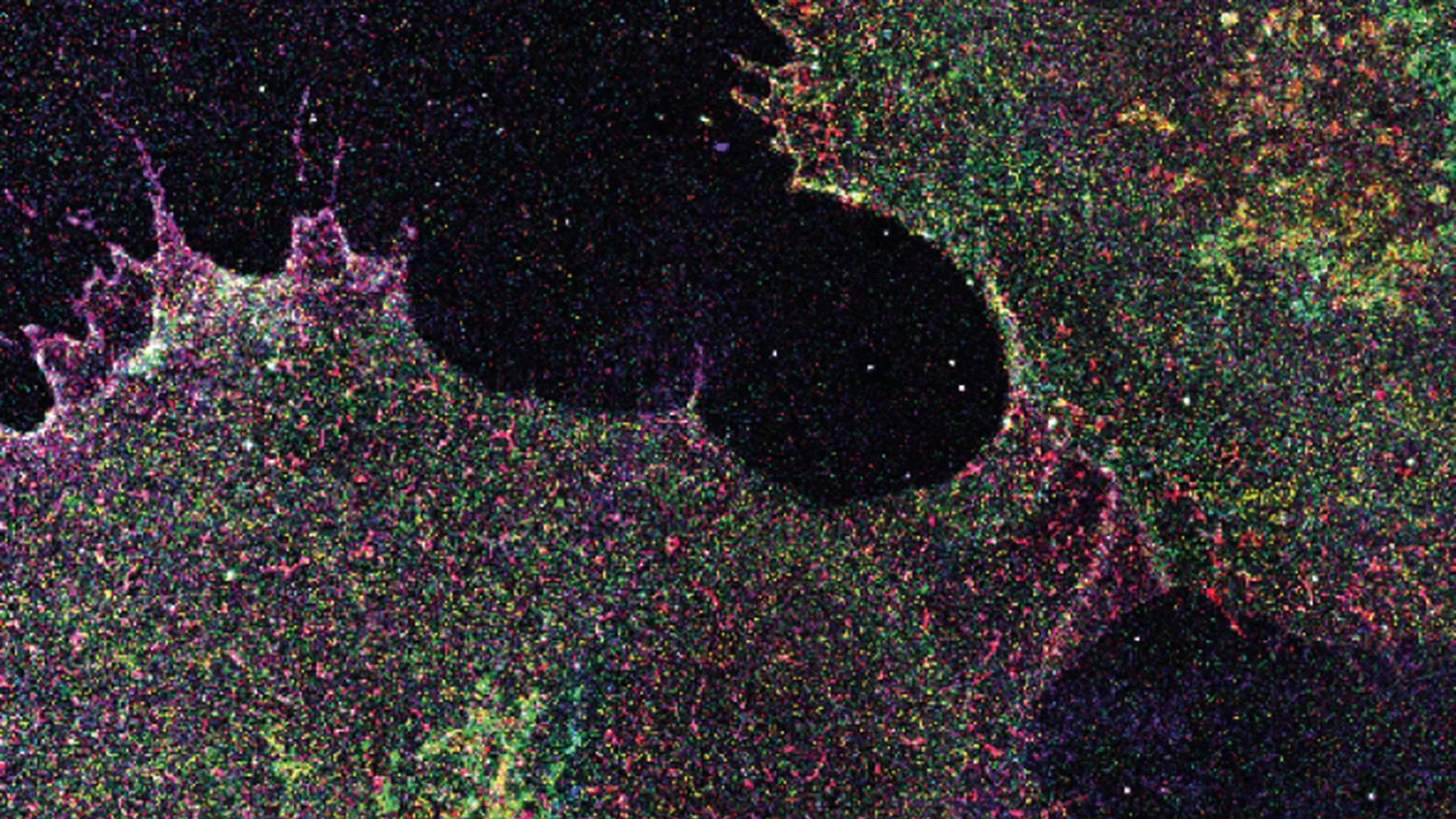
Every human cell is covered by a thin layer of sugars called the glycocalyx. This outer coating helps cells interact with their surroundings and may also provide important clues about what is happening inside the cell itself. Researchers at the Max Planck Institute for the Science of Light (MPL) have now created detailed maps of these sugar structures using advanced high resolution microscopy. Their findings, published in Nature Nanotechnology, suggest that changes in the arrangement of these sugars could one day help doctors detect diseases such as cancer. The glycocalyx surrounds all human cells like a protective outer shell. Rather than remaining fixed in place, these complex sugar molecules constantly shift and reorganize. Scientists in the "Physical Glycosciences" research group, led by Prof. Leonhard Möckl at MPL, study how this sugar coating behaves and what it reveals about cell biology. To investigate these structures, the team developed a technique called "Glycan Atlasing." Using cutting edge super resolution microscopy, they mapped the glycocalyx at the level of individual sugar molecules across many different types of cells. Their work included cell culture lines, primary human blood cells, and tissue samples. The resulting maps showed that the glycocalyx changes its molecular arrangement depending on the condition of the cell. For example, immune cells displayed different sugar patterns after being stimulated, similar to what happens during an immune response. According to the researchers, this provides the first direct evidence that the glycocalyx functions almost like a display screen, showing information about a cell's internal state on its outer surface. The team found that these nanoscale sugar patterns could reliably distinguish between different cellular states. Their measurements allowed them to identify separate stages of cancer development, tell the difference between activated and inactive immune cells, and distinguish cancerous regions from healthy regions in human breast tissue. The findings suggest that the cell surface contains structured biological information that can be read using a standardized approach. "The results provide a promising foundation for the development of future diagnostic methods, as Glycan Atlasing delivers reliable results even in complex samples," explains Möckl, the study leader and corresponding author. The researchers now plan to expand the method by analyzing additional target structures and automating more of the process. They also hope to study much larger numbers of samples so the technique can eventually be adapted for routine medical use. "In large-scale studies, we want to investigate which surface...
Hidden sugar patterns on human cells could reveal cancer early
Original Source: Read on Publisher Website
Vocabulary & Phrases
| Word | Meaning | Example |
|---|---|---|
| nanotechnology | The manipulation and engineering of matter on an atomic and molecular scale, typically at dimensions between 1 and 100 nanometers. | "Researchers are utilizing nanotechnology to deliver chemotherapy drugs directly to cancer cells while sparing healthy tissue." |
| glycosciences | the multidisciplinary scientific field that studies the structure, biosynthesis, and biological functions of glycans (complex carbohydrates and sugar molecules), as well as how they interact with proteins and lipids in living organisms | "Recent advancements in glycosciences have allowed researchers to develop new targeted therapeutics by decoding how sugary molecules on the surface of cells interact with viruses." |
| corresponding | matching, connected, or directly related to something else | "The Spanish word for 'one' is 'uno,' and the corresponding word for 'two' is 'dos'." |
| measurements | the act of determining the size, length, or amount of something, or the specific numerical result obtained by doing so | "The tailor required a careful measurement of the customer's chest and waist for the new suit." |
| standardized | changed or maintained to conform to a specific rule, model, or standard | "The manufacturing company implemented a standardized procedure for assembling its engines, ensuring that every unit produced meets the exact same quality and safety requirements." |
| surroundings | refer to the immediate environment, scenery, conditions, or the places and objects that are all around you | "It takes a few days to get used to the sights and sounds of your new surroundings." |
| investigate | to carefully examine the facts of a situation, event, or crime to discover the truth | "The police are still investigating the cause of the fire to determine if it was an accident." |
| distinguish | to recognize the difference between two or more things, or to possess a quality that makes something special or unique | " It is important to distinguish between scientific fact and fiction." |
Let's Discuss
Who is most affected by this news?
Comments (0)
No comments yet. Be the first to share your thoughts!
Leave a Comment